
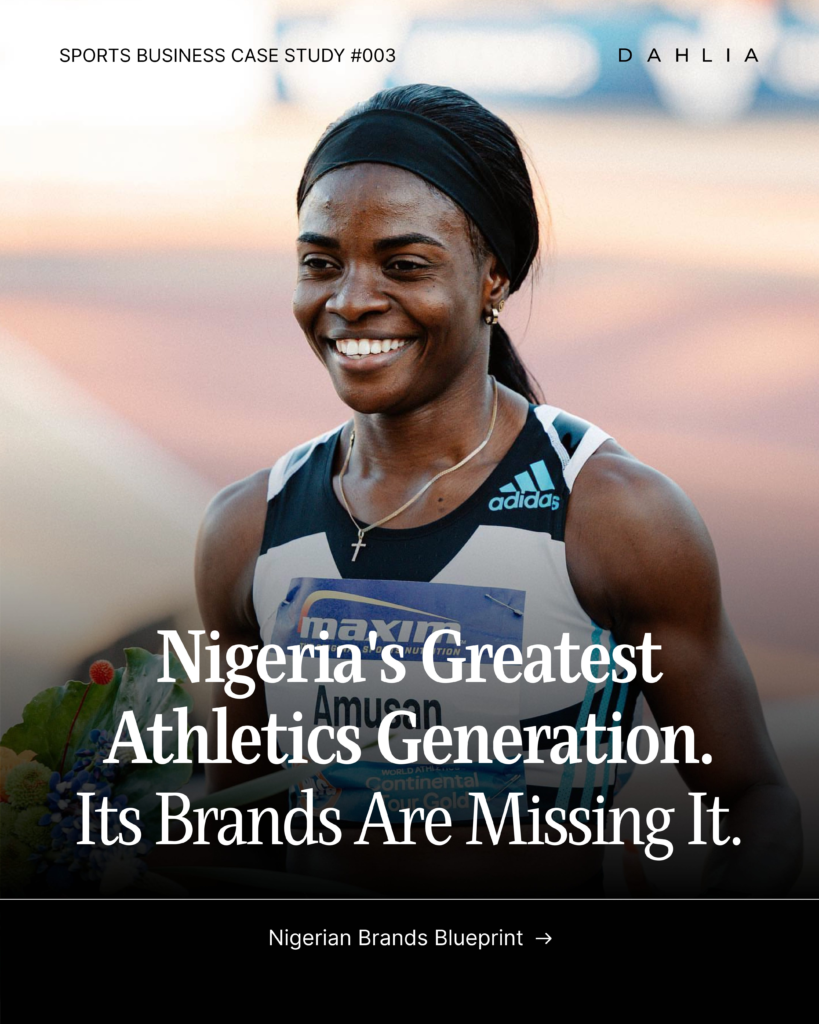
Nigeria is producing the greatest generation of track and field athletes in its history. Six of them are ranked in the world’s top 10 in their events. Not one of them holds a major Nigerian consumer brand partnership.
Six Nigerian athletes. Six world top-10 rankings. Six unsigned with Nigerian brands. That’s not a sponsorship gap. It’s a strategic failure.
The pattern is global and consistent: the brands that build real legacy in athletics are the ones that sign athletes before the headline, not after it.
The problem with the status quo
Nigerian brand sponsorship in athletics runs on a reactive cycle. Brands wait for the world title, then move. By the time they do, the story has already been told without them, the athlete’s price has gone up, and international brands have already locked in relationships.
Glo signed Tobi Amusan a full month after she won the 2022 World Championship gold. That’s not a one-off. It’s the pattern. And the cost of repeating it with this generation is higher than it has ever been. This cycle will keep playing out unless the approach changes structurally.
The brands sitting on the sideline
The brands positioned to change this are Nigeria’s telcos, fintechs, and consumer brands with youth mandates: MTN, Glo, Airtel, OPay, Moniepoint, Milo, Access Bank, and
Indomie.
Every one of them has a sports marketing budget. Every one of them has a youth audience. None of them has secured a partnership with any athlete in this generation. The commercial territory is wide open.
The shift required is simple to state and hard to execute: move from a reward model (signing athletes after they win) to a relationship model (building with athletes while they rise).
Why is this bigger than marketing?
The synergy between this generation and Nigerian brands isn’t a marketing proposition. It’s a national identity proposition.
These athletes are Nigerian, globally ranked, and just getting started on careers that will run through the 2026 Commonwealth Games, the 2027 World Championships, and the 2028 Los Angeles Olympics. The brand that builds with them now doesn’t just buy visibility. It earns the right to say it was part of the story from the beginning.
Six athletes. Six national or near-record marks. Zero Nigerian brand deals. This year alone, Ajayi ran 9.84 to break Nigeria’s 20-year-old 100m national record, then went on to win the 2026 NCAA Outdoor title before beating reigning world champion Oblique Seville to win the Prefontaine Classic on his Diamond League debut. Ogazi ran 43.38 to win the 2026 NCAA Outdoor 400m title, shattering the NCAA collegiate record and moving to fourth on the world all-time list. Both are 2026 NCAA champions. Both broke long-standing records to get there. This is not potential. This is happening right now.
What this looks like in practice
Access Bank. The bank has been the title sponsor of the Lagos City Marathon since 2016: 100,000+ participants, an elite international field, one of the largest road races on the continent, and the most significant athletics sponsorship held by any Nigerian bank. But the marathon is one day a year. This generation competes 52 weeks a year on the global stage, and Access Bank isn’t in that conversation.
The move is straightforward: build an Access Bank athlete program that sits alongside the marathon, not separate from it, year-round content connecting Nigerian speed on the track to Nigerian ambition in everyday financial life.
Milo Nigeria. Milo’s brand positioning is expiring. “Future Champions” is a child-facing, mother-mediated message. It was the right strategy for six decades, but Nigerian Gen Z and young adults don’t see Milo as their brand. It’s what their parents gave them.
The rebrand has to solve for cultural relevance with a generation that has grown up and moved on, without abandoning the household equity that 60 years in market has built. The answer is standing right in front of them: retire “Future Champions.” Replace it with “Current Champions.” The athletes already exist. Milo needs to claim them before someone else does
The next move
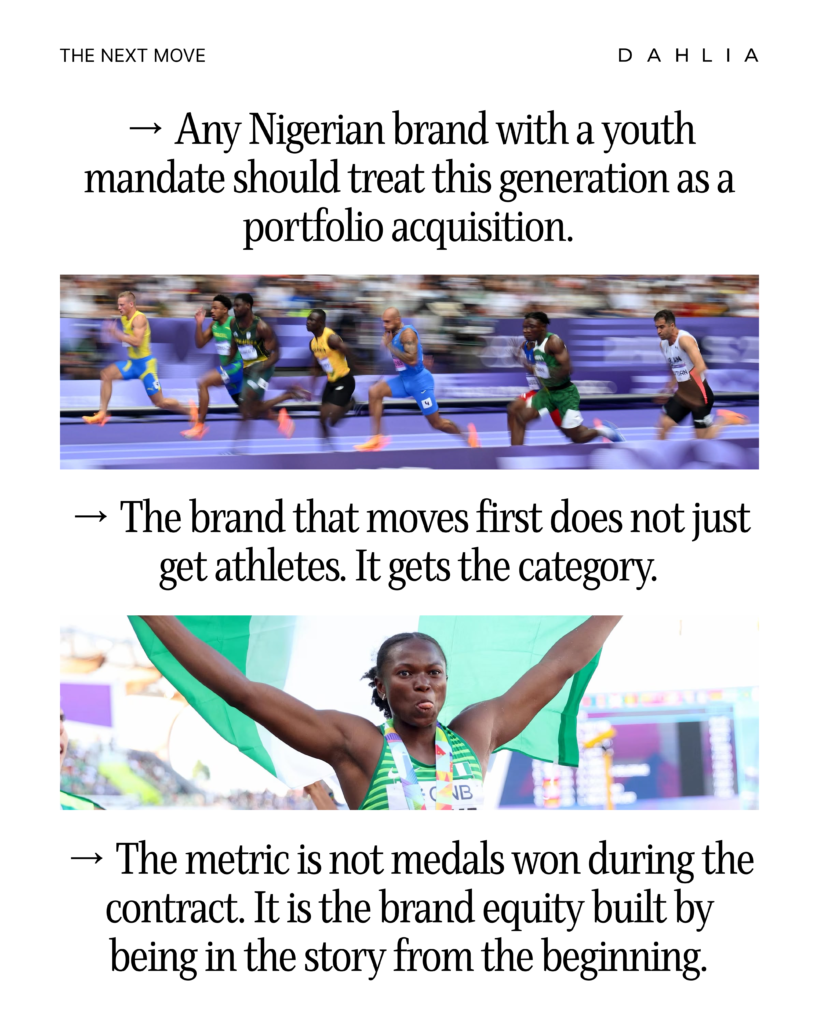
→ Any Nigerian brand with a youth mandate should treat this generation as a portfolio acquisition.
→ The brand that moves first doesn’t just get athletes. It gets the category.
→ The metric isn’t medals won during the contract. It’s the brand equity built by being in the story from the beginning.
The brands that build legacy in sports aren’t the ones that sign champions. They’re the ones that help make them.
Nigeria has the greatest generation of track and field athletes in its history. They’re ranked in the top 10 in the world. They’re breaking records that have stood for decades. They’re competing at the Olympics, World Championships, and Diamond Leagues.
And they’re doing it without a single major Nigerian consumer brand in their corner.
Dahlia Consulting · Nigerian Brands × Athletics · Case Study 003