
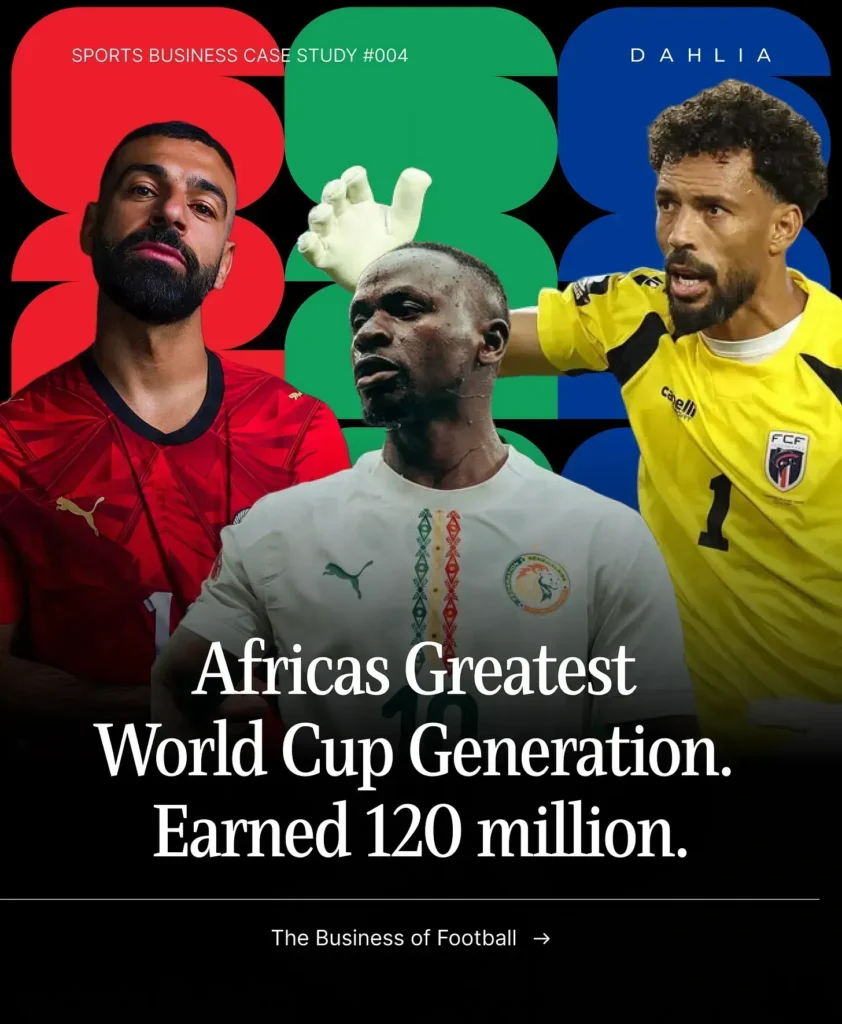
The 2026 FIFA World Cup marked the most dominant collective showing in African football history. Ten nations qualified, a new record. Nine reached the knockout rounds, another record, more than doubling the continent’s previous best of six qualifiers in 2010. And collectively, African teams earned $120 million in performance-based prize money from a single tournament.
This isn’t a story about potential anymore. It’s proof.
The Record Breaking Run
Africa’s football history has been building to this moment for nearly a century.
Egypt debuted in 1934, the first African nation ever at a World Cup. Tunisia became the first African nation to win a World Cup match in 1978, defeating Mexico 3-1. Cameroon became the first African team to reach a quarterfinal in 1990, powered by Roger Milla’s iconic run. Senegal reached the quarterfinals on their 2002 debut, the first Sub-Saharan African team to do so. Morocco became the first African and Arab nation to reach a World Cup semifinal in 2022.
2026 marks the first time nine African teams simultaneously reached the knockout stage.
Key commercial insight: $120M earned by 10 African teams from a single tournament is nearly equivalent to CAF’s entire TotalEnergies headline sponsorship deal roughly $375M over four years, or about $94M per year. One World Cup generated more than a full year of CAF’s headline sponsorship value, purely from performance-based prize money.
The lever isn’t just sponsorship. It’s performance volume.
Who Carried the Run
The 2026 run was built on a combination of established stars anchoring credible national programs, and underdog moments generating outsized global attention.
Morocco: was carried by European-league stars Hakimi, En-Nesyri, and Bounou. Their quarterfinal run was continuity, not a surprise. That continuity is exactly what sponsors need to build multi-year activation deals.
Egypt / Mohamed Salah: Salah’s panenka penalty in the shootout win over Australia was the single most-watched African football moment of the tournament.
Cape Verde: a nation of 525,000 people, zero prior World Cup appearances, took defending champion Argentina to extra time on debut.
South Africa and Ivory Coast: both reaching the knockout stage for the first time gave two large, commercially underdeveloped football markets a global stage moment.
African Viewership
2.1 billion — cumulative viewers across the Middle East and North Africa for matches involving Arab nations (Morocco, Egypt, Algeria, Tunisia).
Source: beIN Sports
192.6 million — viewers for Egypt’s Round of 16 match vs. Argentina, the most watched Arab team match of the tournament. 94% of Egypt’s adult population watched.
151.6 million — viewers for Morocco’s quarterfinal vs. France, despite an 11 pm kickoff. 97% of Morocco’s adult population watched.
81.1M → 149M → 192.6M — the audience grew with every knockout round Morocco and Egypt advanced through.
SuperSport/DStv: Broadcast all 104 matches live across English- and Portuguese-speaking Africa for the first time, reaching all 10 qualifying nations’ home markets.
The gap: North Africa has hard, sourced audience numbers. Sub-Saharan Africa has record-breaking access but no published continent-wide ratings. A measurement gap CAF and broadcasters could close to prove audience value to sponsors better.
The Next Move
Here’s the real test, what happens to that $120 million?
Federations should agree on a mandatory reinvestment floor of 20 to 25 percent of every prize dollar flowing directly into grassroots infrastructure: academies, coaching education, and women’s football. On $120M, that’s $24 to $30 million back into the ground level of African football in a single cycle.
National federations should also use this prize money cycle to invest in domestic league infrastructure, reducing the age at which elite talent exits the continent, and keeping a share of that commercial value at home.
The federations that build a lasting legacy from this generation won’t be the ones that just banked the prize money. They’ll be the ones that reinvested it.
The next move determines whether this becomes a single great tournament or the start of a structurally stronger era for African football